Brazil Green Steel Under CBAM: Production Routes, Trade and Export Costs
Market
Brazil's low-emission steel opportunity is developing while its existing mills lose domestic volume to imports.
The country produced 33.34 million tonnes of crude steel in 2025, 1.6% less than in 2024. In the first quarter of 2026, Brazilian crude-steel output fell another 4.2% year on year to 7.98 million tonnes. Rolled-steel imports rose 20.5% to 5.7 million tonnes and reached 21% of apparent consumption, more than double the historical import penetration reported by Instituto Aco Brasil. China supplied 64% of those imports.
Brazil's steel trade with the EU has moved in cycles
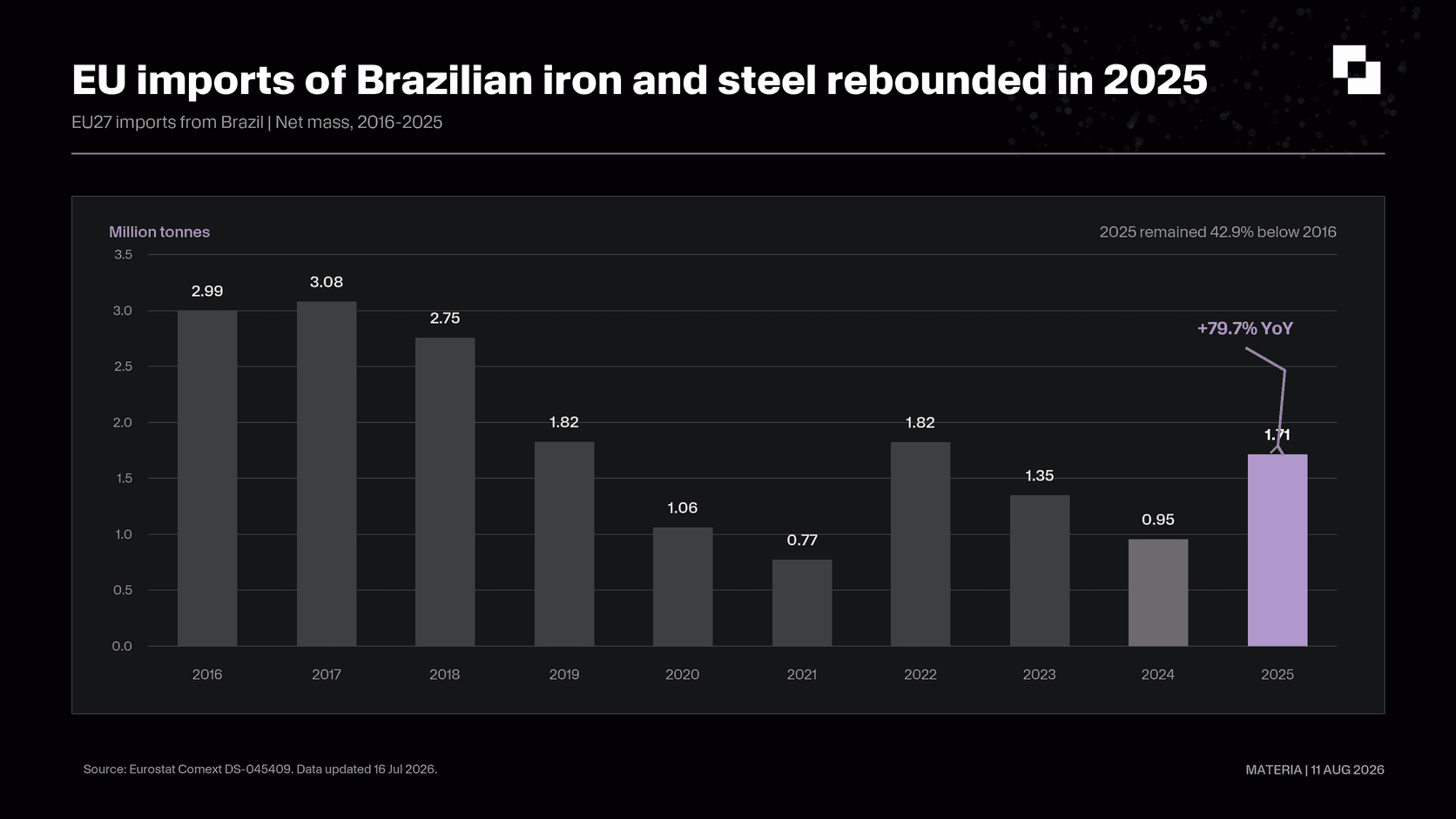
Eurostat records EU27 imports of Brazilian iron and steel at 1.71 million tonnes in 2025, 79.7% above 2024 but still 42.9% below 2016. The rebound followed two years of contraction and recovered part of the earlier decline; it did not establish a decade-long growth trend.
Slab is central to this trade. European rerollers can buy Brazilian semi-finished steel when they need external feedstock while retaining rolling and finishing in the EU. Brazilian volumes are therefore exposed to changes in European steel demand and upstream availability, while quotas and other trade measures determine how much of that commercial demand can enter the market without an additional duty.
Clean electricity helps, but the ironmaking route decides most emissions
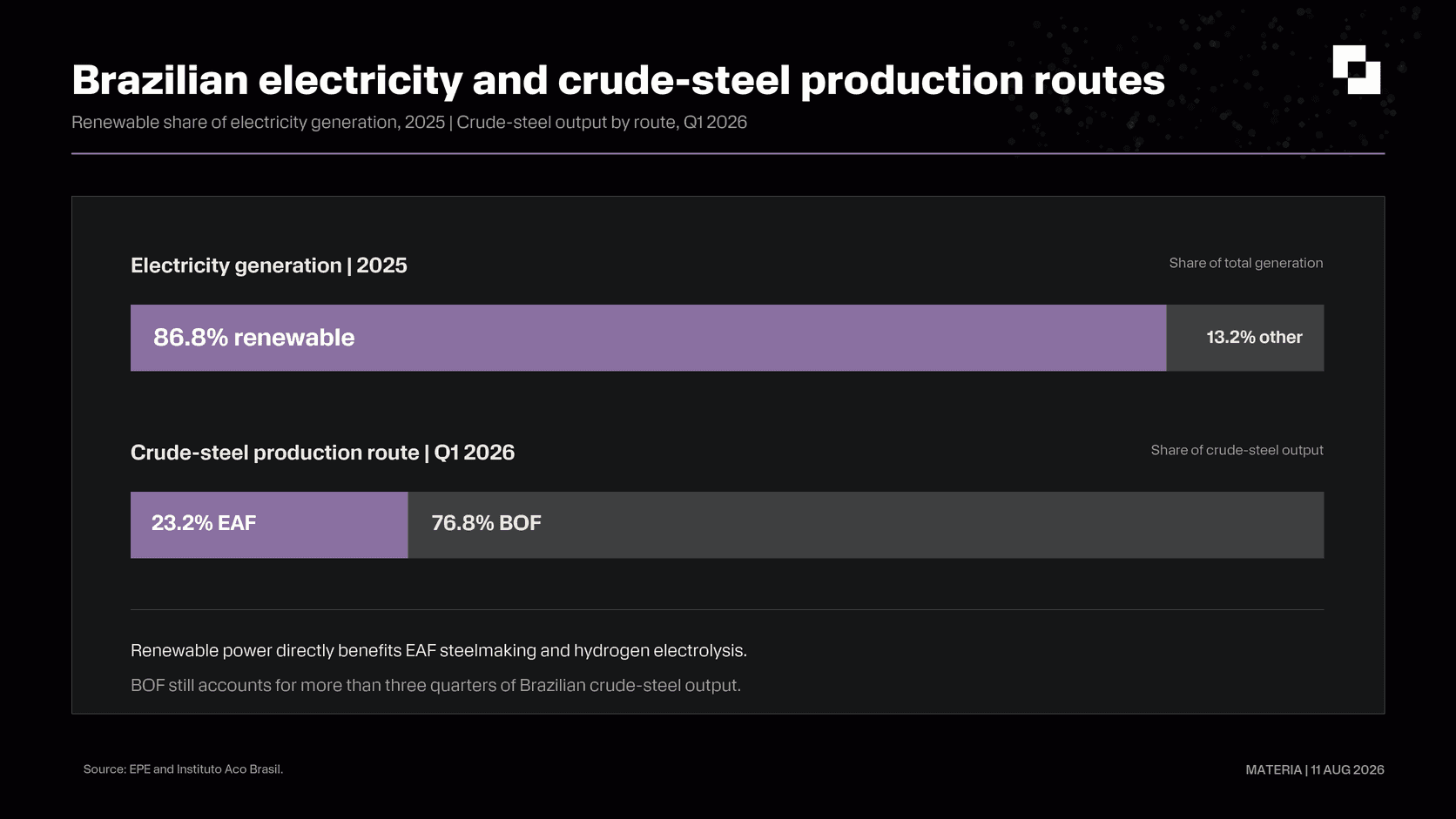
Brazilian steelmaking, including renewable hydrogen, has a lower electricity-related emissions base than coal-based steelmaking, as 86.8% of Brazil's electricity came from renewable sources in 2025. Wind and solar contributed 26.4%.
The current production mix limits the immediate benefit. In the first quarter of 2026, 76.8% of Brazilian crude steel came from the basic oxygen furnace (BOF) route and 23.2% from electric arc furnaces (EAF). For an integrated mill, most emissions arise before rolling, when coke reduces iron ore in the blast furnace. A renewable grid lowers the electricity component, but it does not remove the carbon used in that reaction.
Brazilian iron ore can support a different route. High-grade, low-gangue ore is suitable for direct reduced iron (DRI) and can reduce the energy and slag burden in an EAF. RMI identifies the combination of ore quality and renewable resources as the basis for a competitive Brazilian green-iron industry, although the country has no operating DRI base at the scale needed to change its present production mix.
The projects announced in 2026 are early industrial steps. Axia Energia and GIZ are developing a renewable-hydrogen plant of up to 10 MW for low-carbon steel applications, while CSN's Selene project in Araucaria is designed to produce 709 tonnes of renewable hydrogen per year. Both can establish operating experience and certification methods, but their scale remains small beside a steel industry producing more than 30 million tonnes per year.
Brazil also has experience using charcoal in ironmaking. Renewable biomass can reduce fossil-carbon use, provided the wood source, land-use effects and kiln emissions are accounted for. In 2025, Brazilian environmental authorities secured a BRL 75 million penalty against a steel producer over charcoal received without verified legal origin. The route's carbon performance therefore depends on both the furnace process and the biomass supply chain.
CBAM separates Brazilian steel by product, route and plant
The European Commission's current Brazilian default values vary by customs classification. They include 1.478 tonnes of CO2 equivalent per tonne for pig iron under CN 7201, 1.620 for hot-rolled flat products under CN 7208 and 1.730 for CN 7209 and 7210. The legally applicable value depends on the complete product classification and production-route indicator.
Those defaults do not describe every Brazilian mill. An EAF using Brazil's renewable power mix can have a different emissions profile from an integrated blast-furnace site. A producer using verified installation data below the applicable default can transfer part of that advantage to an EU customer. A plant without acceptable data is valued through the Commission's default even when its physical process performs better.
The carbon cost is only part of the landed-price comparison. Brazilian flat steel and semis also enter a European market governed by tighter steel quotas, a 50% out-of-quota duty and melt-and-pour traceability. Buyers comparing two Brazilian offers need the correct CN or TARIC code before comparing emissions.
Brazil's regulated carbon market, the Sistema Brasileiro de Comercio de Emissoes (SBCE), can improve the monitoring infrastructure used by steel installations. It will not create an automatic CBAM exemption. The current implementation schedule points to monitoring and reporting during 2028-2029 and the first National Allocation Plan in 2030. Under EU rules, only an eligible carbon price effectively paid in Brazil can be deducted from the CBAM liability, supported by the required evidence.
From pilot projects to exportable low-emission steel
Hydrogen-based ironmaking requires new reduction capacity at a time when domestic mills are losing volume to imports. Europe can provide part of that demand. CBAM increases the value of measured emissions performance, while automotive procurement and public purchasing are creating demand for steel with a documented carbon footprint.
Brazil can serve that market through lower-emission finished steel or export DRI and hot-briquetted iron for use in European EAFs. The better route will depend on renewable-hydrogen cost, shipping economics and where the final steel grades are qualified.
For CBAM procurement, Brazilian steel must be compared at facility level. In PATCHWORK, buyers can filter Brazilian steel by facility, production route and product code, compare the applicable country default with facility-level estimates and follow the projected CBAM-adjusted cost through 2034.
