EU CBAM Guidance 2026: What Changed and What Did Not
Policy
On 14 August 2026, the European Commission published ten guidance documents for the definitive phase of the Carbon Border Adjustment Mechanism (CBAM). The 470-page package covers the general methodology, the free-allocation adjustment and separate guidance for cement, hydrogen, fertilisers, iron and steel, aluminium and electricity.
The publication changes no CBAM obligation. The documents are explanatory and non-binding. The calculation of embedded emissions remains governed by Commission Implementing Regulation (EU) 2025/2547, while Commission Implementing Regulation (EU) 2025/2620 governs the free-allocation adjustment. The legally binding default values remain those adopted under Commission Implementing Regulation (EU) 2025/2621.
The August package translates those rules into monitoring instructions, decision trees and worked examples. An importer already applying the definitive regulations correctly should not calculate a different number solely because the guidance was published.
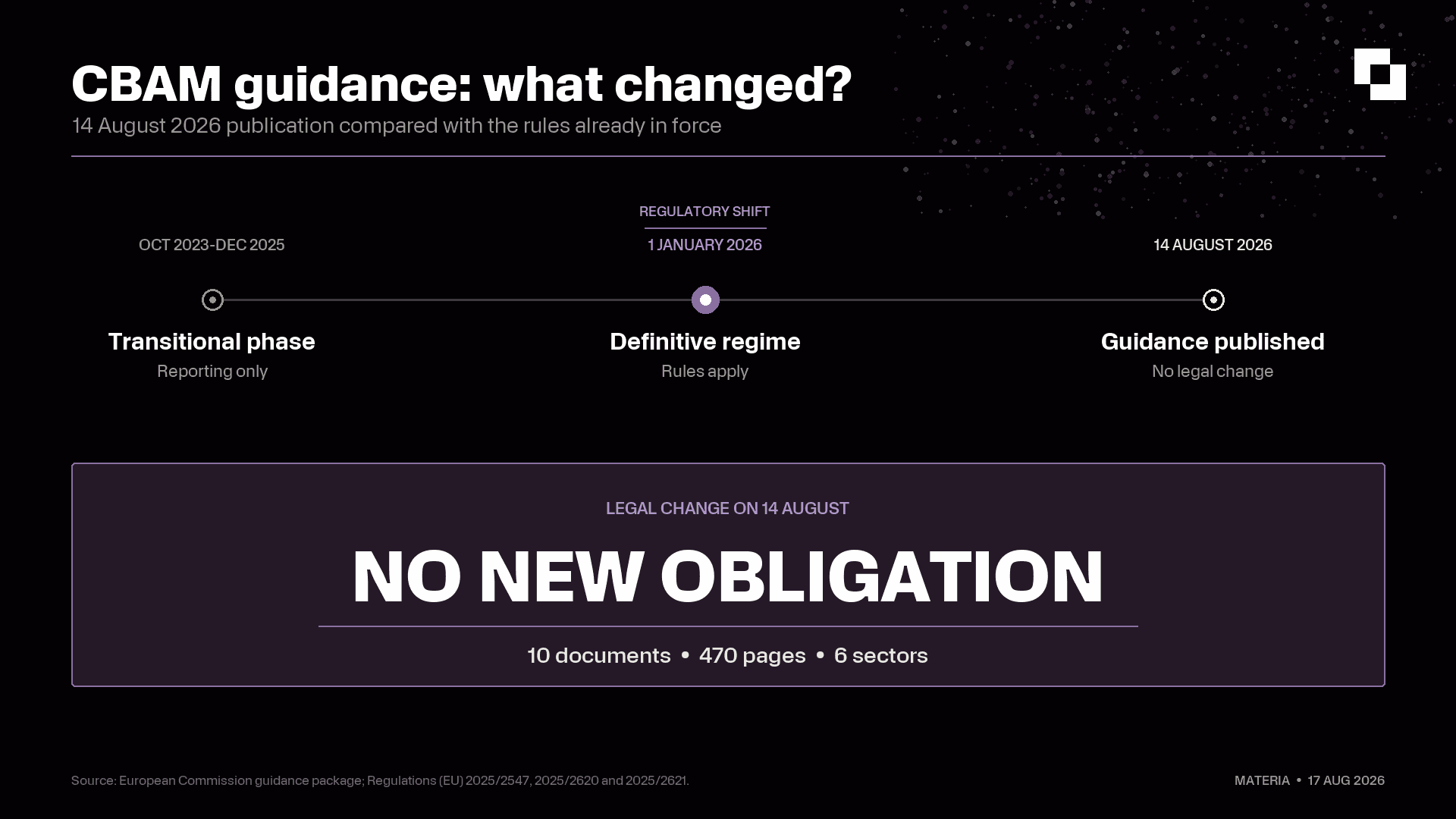
The regulatory change occurred before the guidance
The previous calculation methodology was Commission Implementing Regulation (EU) 2023/1773, which applied during the transitional period from October 2023 to December 2025. Importers reported embedded emissions during that phase but did not buy or surrender CBAM certificates.
The definitive methodology has applied since 1 January 2026. Importers may use the legally established default values or verified actual emissions. When actual emissions are used, the installation operator must follow the definitive monitoring methodology and provide a verified report. The first annual CBAM declaration for 2026 imports and the corresponding certificate surrender are due by 30 September 2027.
The free-allocation adjustment is also part of the definitive regime rather than a change introduced in August. It reduces the certificate obligation to reflect the free allowances still received by comparable EU production under the EU Emissions Trading System (EU ETS). If an importer declares actual emissions, the producer must also calculate the specific embedded free allocation (SEFA). If defaults are used for emissions, the corresponding default CBAM benchmark is used for the adjustment.
For complex goods, SEFA includes the production process and the free allocation carried by CBAM precursors. The calculation repeats through the precursor chain until it reaches a simple good. These equations and the distinction between actual and default benchmarks were already binding under the December 2025 regulation.
The definitive methodology also introduced reporting-period rules that differ from the transitional approach. Goods imported in 2026 use 2026 as the reporting period even if they were produced earlier. For later imports, the declarant can use the actual production year when sufficient evidence is available. A reporting year before 2026 cannot be used under the definitive methodology.
What the August guidance adds
The guidance consolidates rules that previously had to be read across the CBAM Regulation and several implementing acts. It shows how an installation operator moves from fuel, electricity and material inputs to the figures communicated to the authorised CBAM declarant.
The free-allocation guide explains the difference between the two benchmark columns in the 2025 regulation. Column A contains process-level values used when actual data are available. Column B contains benchmarks for default calculations, with the assumed production route and precursor effects already incorporated. A verified carbon-intensity figure alone is insufficient for an actual-data declaration because the operator must also calculate SEFA on a consistent production route and reporting period.
The sector guides add worked calculations rather than new boundaries. The iron and steel document follows an integrated steelworks, electric arc furnace (EAF) stainless production and screws and nuts made from purchased rod. The downstream example shows how the emissions and free-allocation values attached to the rod continue into the finished fastener calculation. Scrap removed during processing receives zero embedded emissions, while the quantity of rod consumed per tonne of finished goods reflects the production yield.
The aluminium guidance confirms that current CBAM calculations include direct emissions from primary smelting, including carbon-anode consumption and perfluorocarbon emissions. Electricity-related indirect emissions remain outside the current aluminium boundary. Alumina and carbon anodes remain raw materials rather than CBAM precursors, while formed aluminium products inherit the emissions of the unwrought aluminium used in production.
The electricity guide provides the evidence needed to depart from a country or regional default factor. Actual values depend on the conditions already set in the CBAM Regulation, including the contractual link to the producer, network conditions, hourly matching and verified generation data. The guidance illustrates these conditions but does not relax them.
What remains unchanged or unresolved
The package applies the law in force on 14 August. Its free-allocation examples use the current phase-out schedule ending in 2034. The Commission's July 2026 proposal to extend that schedule to 2038 is not included because it has not been adopted.
The guidance also does not implement the proposed extension to downstream goods or the proposed anti-circumvention amendments. The Commission's technical work on possible indirect-emissions coverage for additional sectors has not changed the current treatment of steel, aluminium or hydrogen.
The documents therefore provide no new production routes, certificate prices, default values or sector coverage. Their contribution is a common interpretation of the rules already in force, supported by calculations that operators and verifiers can reproduce.
What companies should check
An importer does not need to revise a calculation merely because the guidance was published. A review is appropriate where the supplier still uses a transitional-period template, provides an unverified carbon-intensity figure without SEFA, or cannot trace the values assigned to purchased CBAM precursors.
The worked examples provide a direct test. The supplier's system boundary, production route, reporting period and precursor treatment should produce the same calculation logic shown in the relevant sector guide. If they do, the August publication confirms the method rather than changing the liability. If they do not, the underlying problem dates from the definitive rules that took effect on 1 January 2026.
The complete Commission guidance package is available here.
