After reviewing the European Commission's 17 July 2026 proposal, its impact assessment and the final 2026-2030 industrial benchmarks, we have updated our European Union Allowance (EUA) price forecast.
The proposal has not been approved. The current European Union Emissions Trading System (EU ETS) trajectory remains legally binding while the European Parliament and Council negotiate COM(2026) 616. However, the proposal has broad political and industrial support, reflects the Commission's response to competitiveness concerns and gives a clearer indication of the policy direction it intends to pursue. Our forecast therefore assigns a realistic probability to the revision progressing in September without treating its adoption as certain.
Probability-Weighted EUA Forecast
The probability-weighted curve combines the current legal baseline with the milder supply and free-allocation path proposed by the Commission. It remains upward sloping because the cap continues to contract, but the increase moderates after 2030 as the proposed flexibility mechanisms begin to influence allowance supply and industrial procurement.
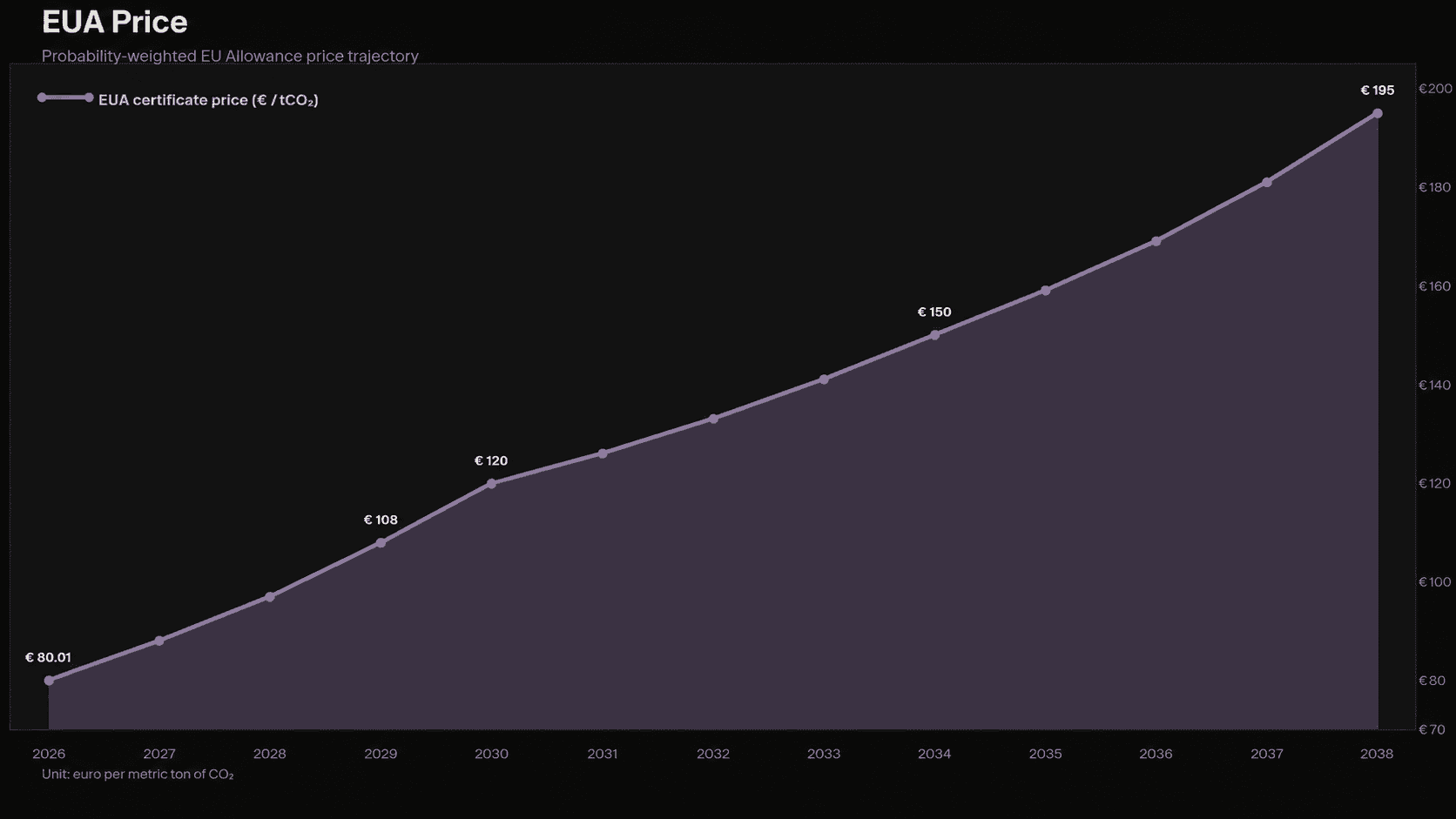
(EUA probability weighted price forecast 2026-2038. Source: Materia)
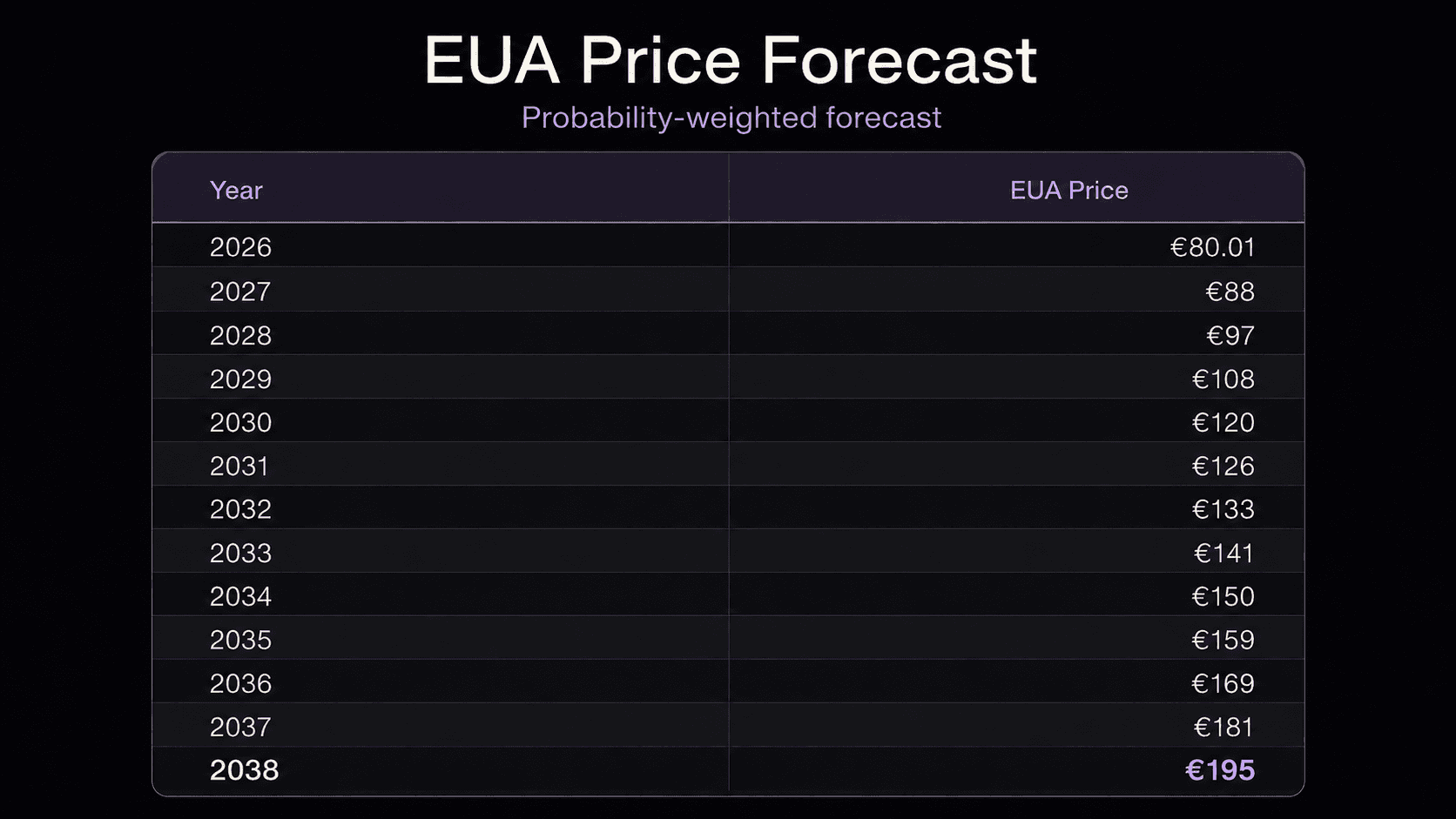
(EUA price forecast table. Source: Materia)
The 2026 value is an analytical annual average built from settled quarterly CBAM certificate prices and our estimates for the remainder of the year. It is not an official annual CBAM certificate price. From 2027, the figures are expected annual averages for EUAs in nominal EUR/tCO2.
Our curve rises more rapidly through 2030, when the existing cap trajectory and near-term auction supply still dominate pricing. Growth then slows during 2031-2035 because the Commission proposes a lower linear reduction factor, a Market Stability Reserve (MSR) calibrated to a contracting market and a longer free-allocation transition for sectors covered by the Carbon Border Adjustment Mechanism (CBAM). The increase accelerates again toward 2038 as free allocation ends and industrial compliance demand becomes more exposed to the market price.
Cap, Removals and the Market Stability Reserve
Current law reduces the cap for stationary installations and maritime transport by 4.3% annually in 2024-2027 and 4.4% from 2028. The Commission proposes a 3.7% linear reduction factor for 2031-2035. From 2036, it would fall to 1.7% if sufficient high-integrity international credits were available, with a 2.7% fallback otherwise. Annual allowance issuance would therefore remain higher during the 2030s than under a continuation of the current 4.4% rate.
International credits are not guaranteed supply. The Commission would assess their availability, integrity and cost before deciding whether to finance up to 260 million tonnes during 2036-2040. Our probability weighting reflects both the presence of this mechanism in the proposal and the uncertainty surrounding its eventual scale.
The permanent-removal programme has a different timing effect. Up to 250 million allowances, plus a possible additional 10 million, could be auctioned during 2031-2040 to finance an equivalent volume of permanent removals in the EU. Selling allowances before every funded removal has been delivered can support tradable supply in the earlier years, while later cancellations preserve the environmental balance of the scheme.
The Commission impact assessment also proposes a more dynamic MSR. From 2028, the intake rate would remain 12% when the total number of allowances in circulation exceeds the upper threshold. A buffer would apply between 833 million and 947 million allowances, while the thresholds and release quantities would decline by 4% annually from 2029. This prevents reserve parameters designed for a larger market from withdrawing an increasing share of liquidity as the cap contracts.
Release would also become graduated. When the total number of allowances in circulation is between 300 million and 400 million, the reserve would release the difference between the lower threshold and circulation. Below 300 million, it would release 100 million allowances. These levels would decline by 4% each year from 2029. The Commission's preferred scenario indicates a flatter indexed price path in 2030-2034 and the first MSR releases around 2038.
Industrial Benchmarks and Free Allocation
Commission Implementing Regulation (EU) 2026/1412 established the binding product, heat and fuel benchmarks for 2026-2030. The values use verified 2021-2022 performance and the annual reduction rates permitted under the EU ETS.
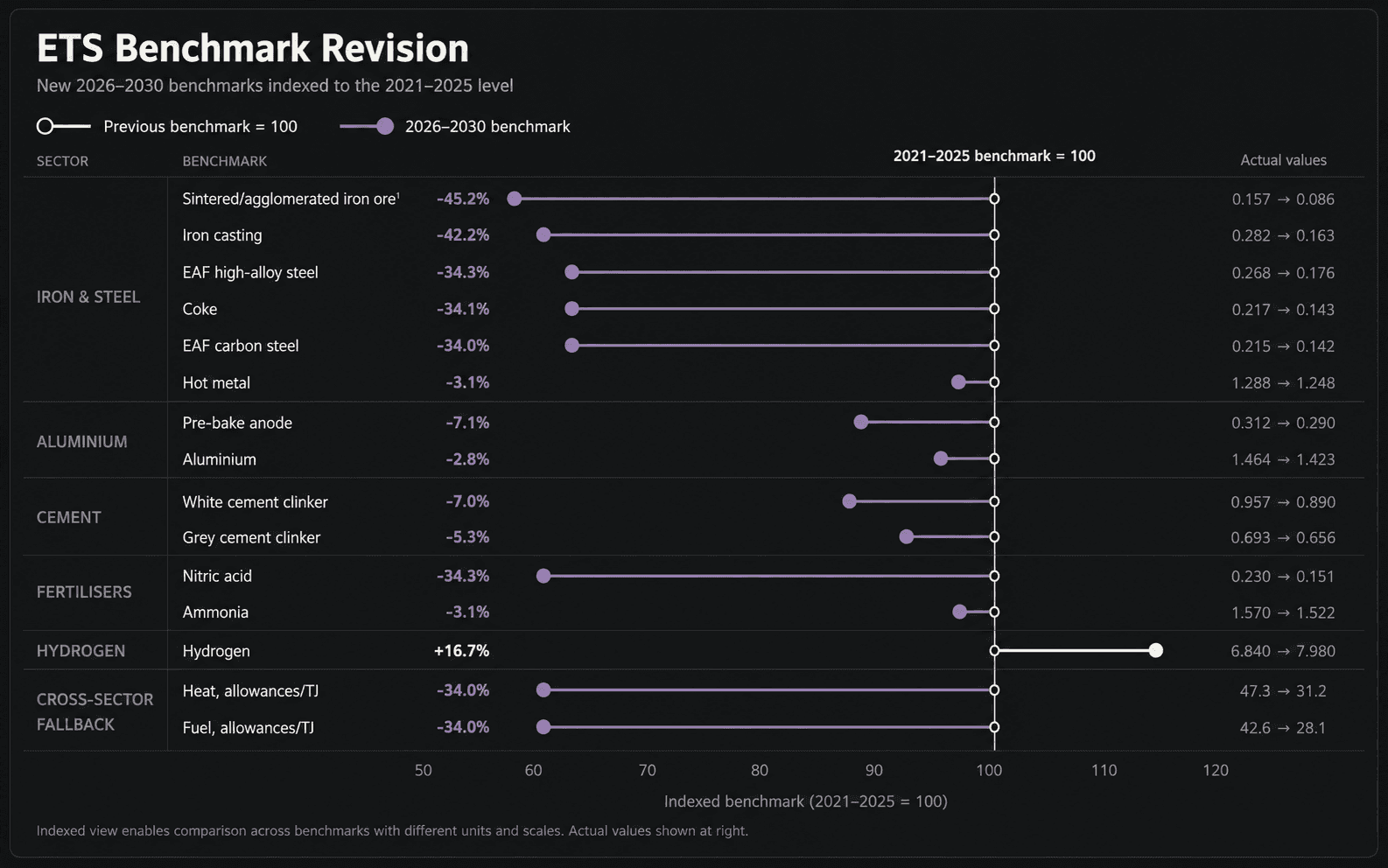
(ETS benchmark detailed revision 2026-2030. Source: Materia)
Hot metal and aluminium retain substantially more benchmark protection than coke, sinter and electric arc furnace steel. The allocation received by an installation still depends on its activity level and the combination of product and fallback sub-installations used in its calculation.
The Commission has separately proposed COM(2026) 619, which would soften the reduction in heat and fuel fallback benchmarks and make approximately 80 million additional allowances available during 2026-2030. A steel plant could benefit where reheating, finishing or auxiliary thermal processes qualify under the fallback benchmarks, but the hot-metal or electric-arc-furnace product benchmark would not receive a direct uplift.
From 2031, free allocation would also be linked more closely to investment. An operator would generally need an Invest in EU decarbonisation plan with eligible EU expenditure equal to the economic value of its five-year allocation. Eighty percent would be issued annually after approval, while the remaining 20% would depend on verification of the investment and emissions conditions.
Transmission to CBAM
CBAM certificates follow EU ETS auction prices, but they are not EUAs and do not remove allowances from the EU ETS cap. Import exposure changes through the certificate price and through the benchmark-based adjustment that reflects the free allocation available to an equivalent EU producer.
The Commission proposes slowing the reduction in that adjustment from 2028. Current law leaves 51.5% of the benchmark-equivalent amount in 2030 and removes it completely from 2034. The proposal retains 59% in 2030 and 15% from 2034 through 2037, with the phase-out completed in 2038.
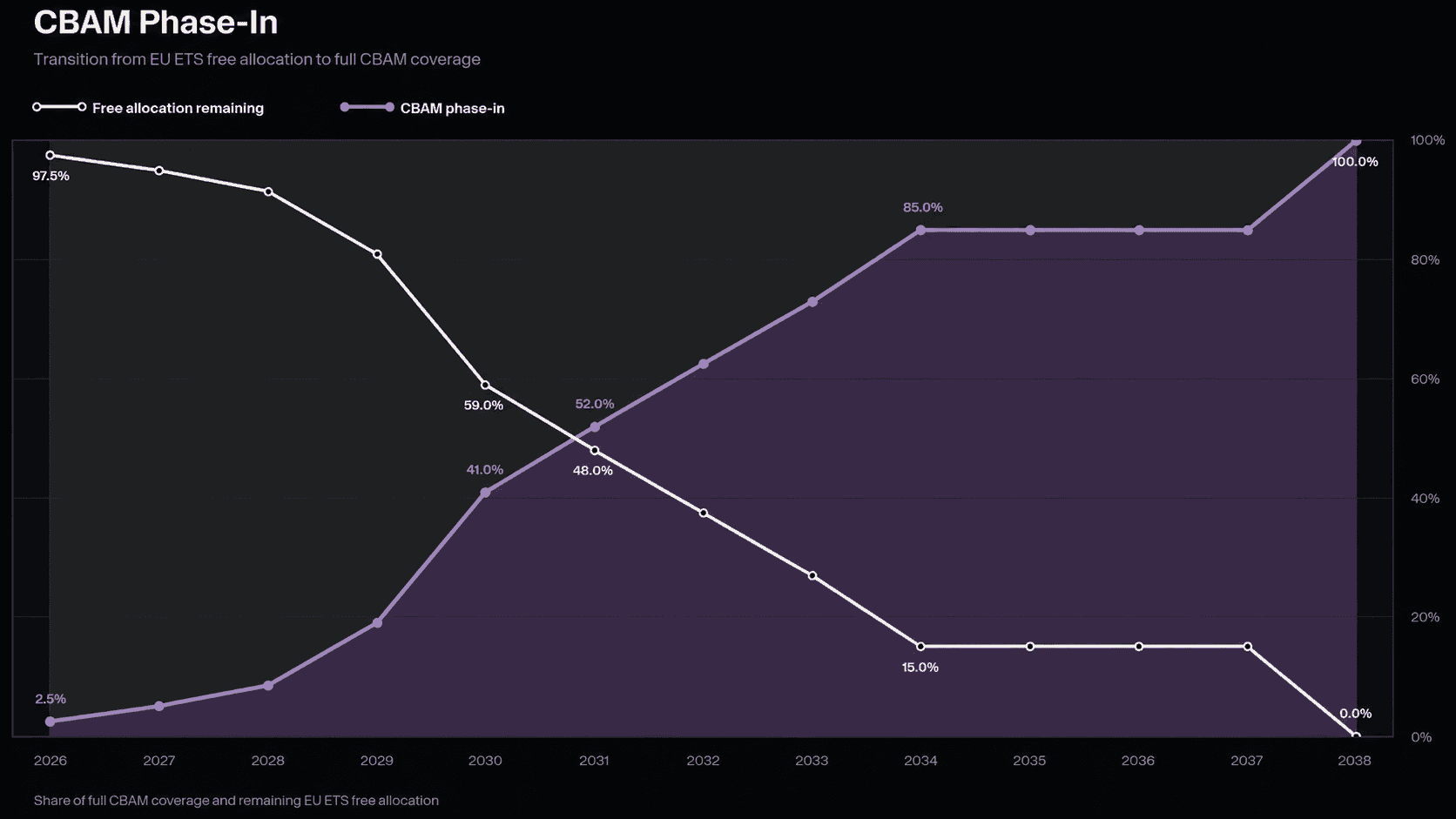
(CBAM phase in free allocation schedule 2026-2038. Source: Materia)
Importers would consequently surrender fewer certificates for the benchmark-equivalent part of embedded emissions if the revision were approved. Emissions above the applicable benchmark would remain exposed, so carbon-intensive production routes would continue to carry a larger CBAM cost than lower-emission alternatives.
The latest benchmark review will also require a separate CBAM update. Regulation (EU) 2025/2620 used estimated 2026-2030 EU ETS inputs because the final benchmarks were not yet available. It provides for a review once those values are published, with updated CBAM benchmarks intended for goods imported from 1 January 2027.
The reconciliation must compare the estimates already embedded in the CBAM calculation with the final values in Regulation 2026/1412. Applying the full reduction from the previous 2021-2025 EU ETS benchmark would count part of the adjustment twice. Steel also requires route-specific treatment because EU ETS product benchmarks can contain indirect electricity components, while current CBAM steel calculations use direct-emission boundaries and precursor assumptions.
Further Revision if the Proposal Is Approved
The probability-weighted forecast already reflects the chance that the Commission's revision progresses in September. If the proposal is approved substantially in its current form, we would revise the curve further downward to EUR 103/tCO2 in 2030, EUR 118/tCO2 in 2034 and EUR 145/tCO2 in 2038 (worst/best case elaborated at the time of writing).
Those values would reflect a confirmed 3.7% linear reduction factor for 2031-2035, the redesigned MSR, the longer CBAM-linked free-allocation transition and the additional supply flexibility proposed for the following years. Until the legislative outcome is clearer, EUR 120/tCO2 in 2030, EUR 150/tCO2 in 2034 and EUR 195/tCO2 in 2038 remain our probability-weighted estimates.
We will reweight the forecast when Parliament and Council clarify the cap trajectory, MSR parameters, international-credit conditions and CBAM phase-out. The heat and fuel benchmark amendment and the revised CBAM benchmark table will be modelled separately because they change allocation and certificate deductions rather than the overall emissions cap.
See how our updated EUA forecast affects CBAM costs on PATCHWORK
