Parliament backs a wider downstream CBAM: what buyers need to prepare
On 15 September 2026, the European Parliament adopted its negotiating position on extending the CBAM to more steel- and aluminium-intensive finished goods. The vote passed by 464 votes to 50, with 159 abstentions, giving Parliament a mandate to negotiate with the Council.
The vote does not put the new product list into force. The Commission proposed the expansion in December 2025 and the Council agreed its own position in June, so the three institutions must now settle the scope and operating rules. Their common direction is clear: selected downstream goods would enter CBAM from 2028. What remains open is which products are covered and how much flexibility the system retains if carbon costs create severe market disruption.
The product list is now the main commercial question
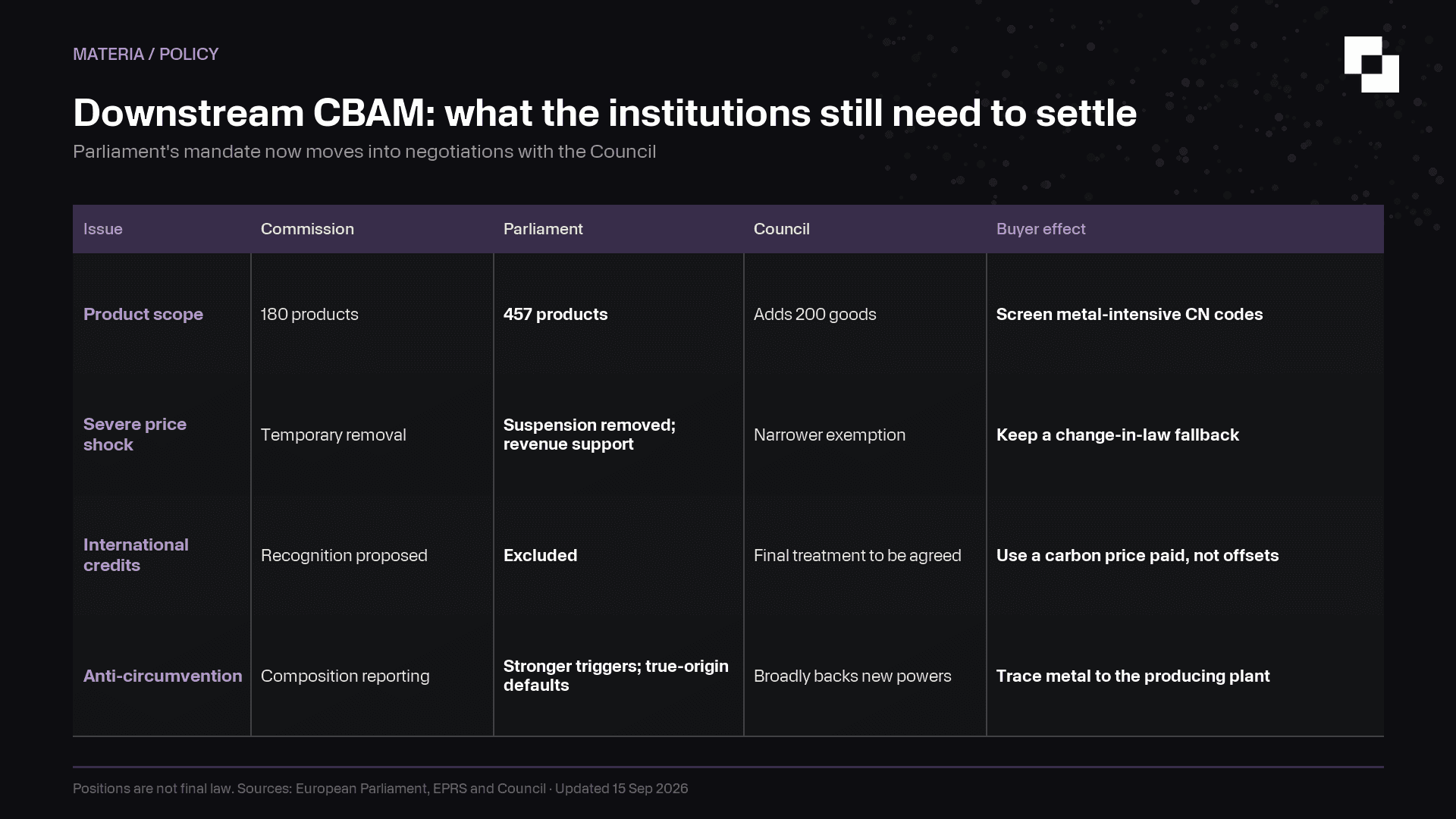
The Commission proposed 180 downstream products whose steel or aluminium content averages 79%. Parliament's position is much wider, covering 457 products, while the Council added 200 metal-intensive industrial, construction and electrical-equipment goods to the Commission list. These are competing negotiating positions, not figures that can be added together, and the operative list will come from the final agreement.
Parliament identifies fasteners, wire, springs and household articles among the types of goods in its perimeter. Current CBAM already covers some manufactured metal articles, but the expansion would reach much further into components, equipment and consumer products whose carbon exposure comes mainly from the steel or aluminium used to make them.
For a buyer, if a finished product is included, the calculation must connect that product to its covered metal input. The importer may need the amount of steel or aluminium used, the installation that produced it, its production route and embedded emissions, as well as evidence of any eligible carbon price paid in the country of origin.
An importer buying a finished component faces a longer data chain than one buying steel or aluminium directly from a mill. Several suppliers and processing stages may sit between the upstream installation and the finished good entering the EU. A component manufacturer may know its purchase specification and invoice but still be unable to identify the plant or verified emissions behind the metal. Where that evidence is unavailable or unusable, the importer may have to calculate exposure with default values.
Parliament chose predictability over a price-shock escape
The Commission proposed allowing selected goods to be removed temporarily from CBAM when serious and unforeseen conditions caused severe harm. The Council kept that route but narrowed it, requiring clearer and more objective criteria, including evidence of severe price increases. Parliament removed it.
Instead, Parliament wants revenue associated with affected goods to be redirected temporarily to the sectors facing the shock. A suspension would remove the border cost from the affected import for a period; revenue support would leave the import obligation in place and compensate industry through a separate mechanism. Which approach survives will affect how importers write change-in-law and carbon-cost clauses into contracts extending beyond 2027.
Parliament also rejected the option of counting international carbon credits when calculating a carbon price effectively paid outside the EU. An eligible foreign carbon tax or emissions-trading payment could still reduce the certificates due, subject to the final rules and evidence, but buying or cancelling a project credit would not qualify through this route under Parliament's position. Exporters planning to rely on offsets therefore need to separate those claims from a carbon price that has actually been paid on the production covered by the shipment.
Low-emission supply needs to be traceable to the plant
The anti-circumvention provisions target small changes to products and trading patterns used to avoid CBAM. Parliament also supports stronger action against resource shuffling, where lower-emission output is channelled to EU customers while higher-emission production continues for other markets without a corresponding reduction at the installation or group level.
If the Commission establishes that pattern, Parliament wants it to be able to use default values reflecting the true country of origin. For procurement, a low emissions figure attached to one cargo may therefore be insufficient if the supplier cannot show how that output was produced and allocated.
The data requirement can affect supplier competition before the first 2028 declaration. Mills and manufacturers able to pass reliable installation and material data through the chain will give importers a firmer landed-cost estimate. Suppliers that cannot do so may still be commercially attractive, but buyers will need to price the risk that default values replace the claimed emissions figure.
Procurement can prepare without treating the mandate as final law
Companies do not need the final list to start screening their exposure. Procurement and customs teams can identify metal-intensive finished imports by CN code and value, then prioritise the products with long contracts, concentrated suppliers or limited substitution. For those products, the useful supplier question is whether the steel or aluminium can be traced to a producing installation with emissions and carbon-price evidence that the importer could use.
A wider downstream perimeter would reduce part of the carbon-cost gap between making a component in Europe from ETS- or CBAM-exposed metal and importing the finished component. It would also move reporting, verification and cash requirements into supply chains that have not previously treated carbon data as customs-critical information. CBAM will still operate alongside safeguards, anti-dumping duties and origin rules, each with its own scope and test.
Parliament also adopted a separate position on a temporary decarbonisation fund intended to address export carbon leakage. It wants the fund to run from 2027 to 2029 and to include fertiliser and downstream operators. That vote is politically connected to the CBAM debate, but it is a separate file and does not yet create support that companies can book.
Every institutional position now supports wider downstream coverage, while Parliament wants tighter evidence against circumvention. The remaining commercial uncertainties are the final product list, the price-shock mechanism and the data standard that will apply in 2028.
