Yesterday, the European Commission proposed replacing the current public procurement directives with one regulation. If adopted, the regulation would make price-quality assessment the standard approach and allow buyers to favour European or internationally covered supply in defined cases. It is not yet law, and current rules remain in force while the European Parliament and the Council negotiate the text. European Commission proposal and supporting documents.
Which public contracts would be covered
The EUR 616 billion figure is the annual average value of procurement governed by the current EU directives, about 5% of EU gross domestic product. It excludes lower-value purchases and exempt markets, which take total government procurement to approximately EUR 2.6 trillion. The proposed regulation would directly cover the above-threshold segment. European Commission impact assessment.
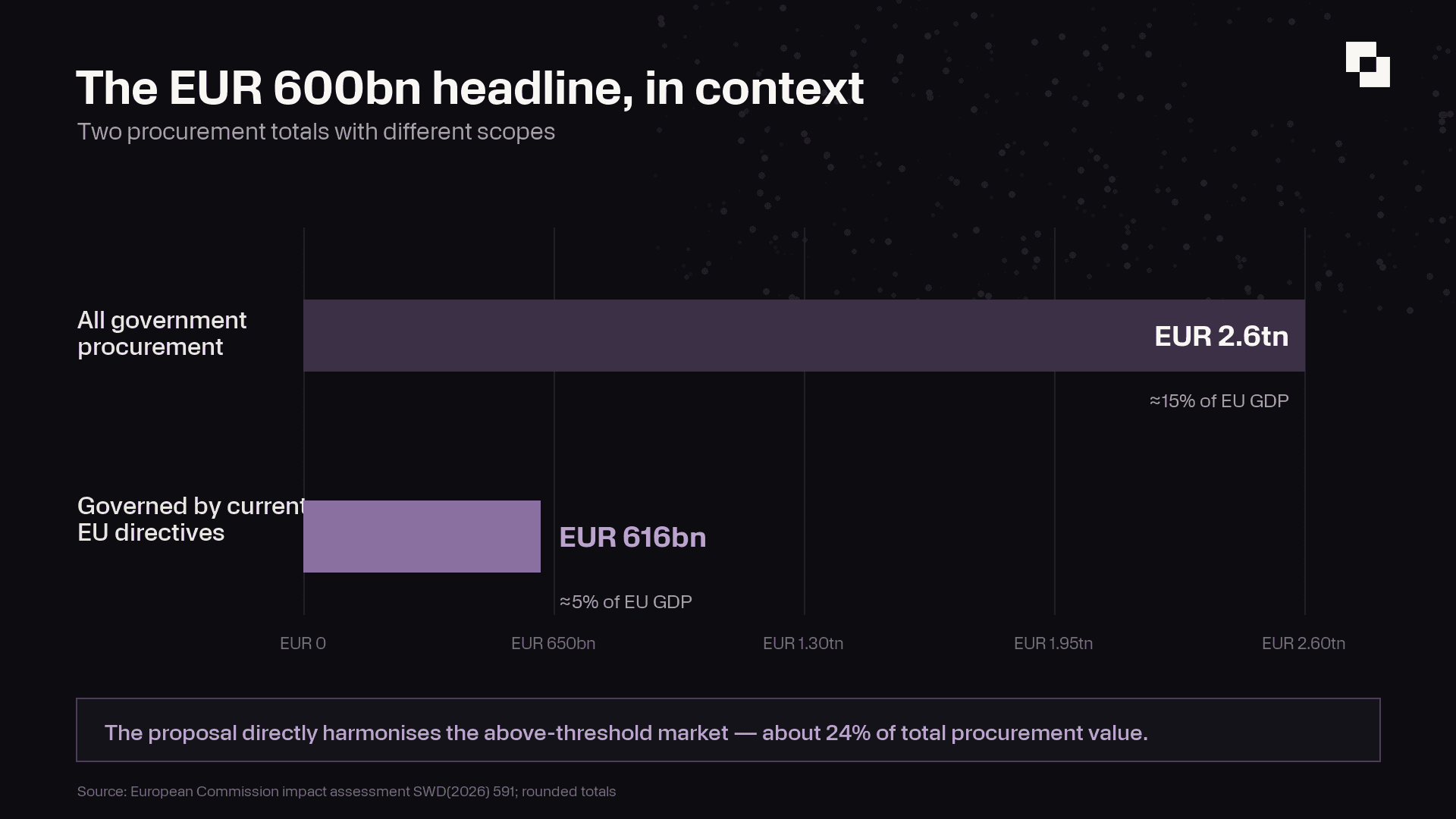
Coverage depends on the buyer, sector and estimated contract value. The same steel or aluminium product may enter a national purchase below an EU threshold and an EU-regulated tender through different procedures.
How an industrial bid would be scored
Quality would account for at least 30% of the award score and at least 50% for labour-intensive contracts. An industrial tender could score measured emissions performance or delivery reliability when the specification defines the metric and the comparison method.
An unsupported lower-emissions claim would earn no points. The supplier would need evidence for the exact material and volume offered, while a delivery claim would need to match the contracted quantity and schedule. A price premium is viable only when the extra quality score is sufficient to offset it.
Which imported products would retain access
A buyer could limit participation, favour European or internationally covered origin in the score, or reject an offer when Union or covered content represents less than half of its estimated value. WTO procurement commitments and EU trade agreements would still require equal treatment when the buyer, contract and product fall within their coverage. World Trade Organization Agreement on Government Procurement.
An EU address on the invoice does not establish product origin. A distributor based in the Union does not turn imported coil or aluminium into European-origin material, so the bidder would need documents tracing where the product was made.
When the specification raises cost
The European Court of Auditors found that more than 40% of public contract awards in 2021 had only one bidder and that the average number of bidders had nearly halved between 2011 and 2021. A condition that only one producer can document may narrow competition further and raise the awarded price. European Court of Auditors, Special Report 28/2023.
Before launch, market consultation would let procurement test how many suppliers can deliver the exact grade and tonnage with the required origin or performance evidence. If only one mill qualifies, the buyer should expect less price competition and possibly a longer lead time.
