Ex Ilva's hot-area shutdown: what changes for Italian steel supply
On Friday, the Milan Court of Appeal rejected Acciaierie d'Italia's request to suspend the order stopping Taranto's hot area. Shutdown operations are due to begin on 16 September so that production can stop by 28 October, unless the required asbestos removal and fine-particle emissions work is completed. A further appeal can continue, but it no longer holds back the deadline.
Only one blast furnace is active and thousands of direct employees are on furlough, leaving current production far below the plant's historical scale. The October order removes the continuity of the existing integrated route while ownership and the investment in replacement technology remain unsettled.
The hot area turns iron ore and coke into crude steel through the sinter plant, coke ovens, blast furnaces and steel shop. Taranto then rolls part of that steel, while coils feed finishing operations elsewhere in the group. Once this route stops, the northern plants can continue only if they receive alternative slab or coil, depending on where rolling takes place.
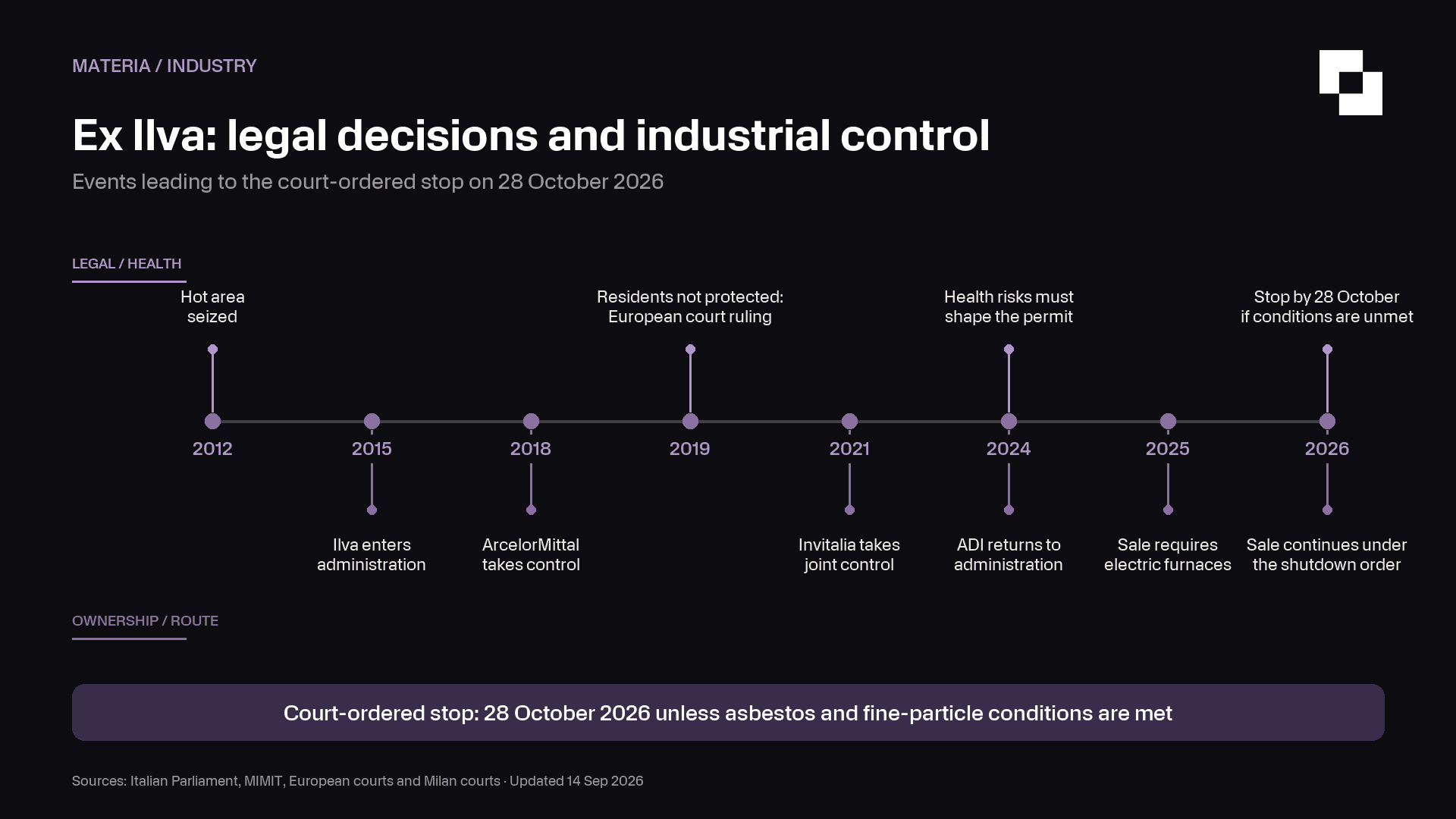
Fourteen years of managed continuity
The present deadline follows a sequence that began in July 2012, when prosecutors seized Taranto's hot-area installations after investigations linked emissions to serious environmental and health harm. The government allowed production to continue under a revised environmental permit and a remediation programme, creating a model in which the site could operate while the required work was completed.
Ilva entered extraordinary administration in 2015. A consortium led by ArcelorMittal won the lease-and-purchase process in 2017 and took operational control in November 2018, but the legal and financial settlement remained unstable. In 2019, the European Court of Human Rights found that Italy had failed to protect residents from the plant's pollution. Later that year, after changes to the legal protection surrounding the environmental plan, ArcelorMittal announced that it would withdraw from the transaction.
A 2020 settlement kept the group operating and opened the door to state participation. Invitalia invested €400 million in 2021, acquiring 38% of the equity and half of the voting rights in the business renamed Acciaierie d'Italia. Production and liquidity continued to deteriorate, and the company returned to extraordinary administration in February 2024.
The legal standard also tightened. In June 2024, the EU's highest court held that health impacts and all relevant pollutants must be considered when the plant's permit is assessed, and that operations must be suspended if they create serious and significant danger. In 2025, the government issued a new permit and relaunched the sale process with a mandatory phase-out of coal-based production and a transition to electric furnaces. That future route was still being negotiated when the Milan court set the current shutdown deadline.
A buyer now inherits the shutdown gap
In February 2026, the Tribunal of Milan ordered the hot area to stop unless asbestos was removed and fine-particle emissions were brought within the required limits. The Court of Appeal confirmed the substance of that order in July, giving the company 90 days, and on Friday it refused to suspend the deadline while the remaining appeal proceeds.
A prospective buyer can no longer value the hot area as a production line that will run until a replacement is ready. The business case has to fund a controlled shutdown and meet the conditions for any restart before it can support an electric-furnace investment. State-backed bridge finance is limited, while it would be nearly impossible to build new furnaces and their direct-reduced-iron supply before the October deadline.
Genoa, Novi Ligure and the group's other finishing sites can operate only if they receive feedstock from another route. External supply may preserve throughput, but it extends working capital and delivery time while customers qualify the replacement material and its melt-and-pour origin. Contractor companies have already warned of around 2,500 dismissals, which were paused while the court considered the suspension request.
Procurement exposure moves upstream
We believe the decision doesn't point automatically to an immediate price spike. Taranto's current production is already low and imported material can replace part of the missing volume. The risk is more likely to appear in qualified-grade availability, replenishment time and the cost attached to a different origin.
EU steel imports now enter under tighter tariff-free quotas, with a 50% duty above the available quota for covered products. Importers also need mill-test evidence of where the steel was melted and poured. Depending on the product code and origin, alternative feedstock can add CBAM exposure as well. A coil finished in Italy may therefore carry the trade and carbon characteristics of the imported steel used to make it.
Procurement teams should first confirm that the replacement grade and mill remain qualified and that delivery fits the production window. The landed-price comparison then needs the melt-and-pour evidence and any quota, duty or carbon cost attached to the origin.
The industrial plan now has two incompatible timelines: weeks to close the hot area and years to finance and build its replacement. Keeping Italy's rolling and finishing capacity in production requires an interim feedstock route, while any future owner still has to fund the environmental work and electric furnaces. The 28 October deadline arrives first.
