On 27 August 2026, Türkiye published the operating regulation for the Türkiye Emissions Trading System (TR-ETS). The regulation joins the country's existing monitoring, reporting and verification framework to a domestic market with emissions permits, allowance allocation and annual surrender.
The regulation sets the permit, allocation and surrender framework. It does not provide enough information to estimate an allowance price or the cost for a Turkish installation. The Carbon Market Board still has to decide which installations enter the pilot and how much free allocation they receive. Until those decisions are published, EU importers cannot assume that TR-ETS will produce a specific deduction from their CBAM liability.
Türkiye's Ministry of Trade reports that the country supplied 18.34 million tonnes of CBAM goods to the EU during the 2023-2025 reporting period, second only to Ukraine. The shipments contained about 42 million tonnes of embedded carbon dioxide equivalent. Türkiye ranked first among origins for EU cement and aluminium imports and fourth for iron and steel.
An output-linked cap with key parameters still open
TR-ETS applies to Category B installations emitting more than 50,000 tonnes of carbon dioxide equivalent a year and Category C installations above 500,000 tonnes. Smaller Category A installations remain under MRV, but they do not surrender allowances. Existing covered installations have until 9 July 2028 to obtain an emissions permit, subject to a possible extension of up to two years.
Each installation reports verified emissions and activity by 30 April. The government then has 60 days to publish the National Allocation Plan, which sets the cap and allocation amounts using the activity recorded for the previous year.
Türkiye has therefore chosen an intensity-based, ex-post cap. Allowance supply follows verified production and the applicable benchmark instead of being fixed in advance as an absolute quantity. If output rises while the benchmark remains unchanged, the cap can rise as well. Lower total emissions will depend on a tighter benchmark or a fall in the emissions intensity of production.
Free allocation is calculated at sub-installation level by applying the benchmark and the Board's allocation rate to verified activity. The remaining allowances can be auctioned through Energy Exchange Istanbul (EPIAS) or transferred to the market stability reserve. Installations may bank or borrow allowances within an implementation period, while the Board will decide how much of an annual obligation can be met with domestic carbon credits.
An installation that has covered at least 70% of its surrender obligation may request allowances from an additional reserve limited to 10% of the annual cap. The minimum price is 50% above the higher recent weighted average in the primary or secondary market.
Several figures included in the earlier draft are absent from the final regulation. The adopted text does not set the pilot calendar or guarantee full free allocation during the pilot, and it drops the proposed 80% reduction in pilot penalties. The first credible assessment of Turkish allowance demand will require the Board's pilot decision and allocation rate.
The Turkish allowance quote is not the CBAM deduction
CBAM certificates are priced from EU ETS auctions. The official CBAM certificate price was €75.36 per tonne of carbon dioxide equivalent in the first quarter of 2026 and €75.28 in the second.
An authorised CBAM declarant may reduce the number of certificates surrendered when a qualifying carbon price was effectively paid in the country of origin for the emissions embedded in the imported goods. The calculation must reflect free allocation and any other reduction in the producer's domestic cost.
A Turkish installation could therefore trade in a market with a positive allowance price while paying little or nothing for the emissions associated with an EU shipment. If free allocation covers its obligation, there is no allowance purchase to deduct. If the installation uses cheaper domestic credits for part of its compliance, the importer cannot apply the full TR-ETS market price to those emissions.
Türkiye has also created a complementary allowance-price mechanism. An installation may voluntarily pay an additional amount on allowances bought in selected primary auctions. Turkish law can record that payment, but EU rules determine whether it qualifies for a CBAM deduction. The importer would need evidence that the payment was effectively borne and relates to the emissions embedded in the imported goods. Türkiye and the EU ETS are not linked, so their allowances remain separate compliance instruments.
When the EU recognises a Turkish carbon payment, that amount reduces the corresponding CBAM obligation. Any difference between the eligible Turkish payment and the EU carbon cost remains payable through CBAM certificates. Our analysis of Brazil's carbon market and steel exports explains how a domestic carbon market could reduce CBAM for steel exports only when the producer has effectively paid a qualifying carbon price.
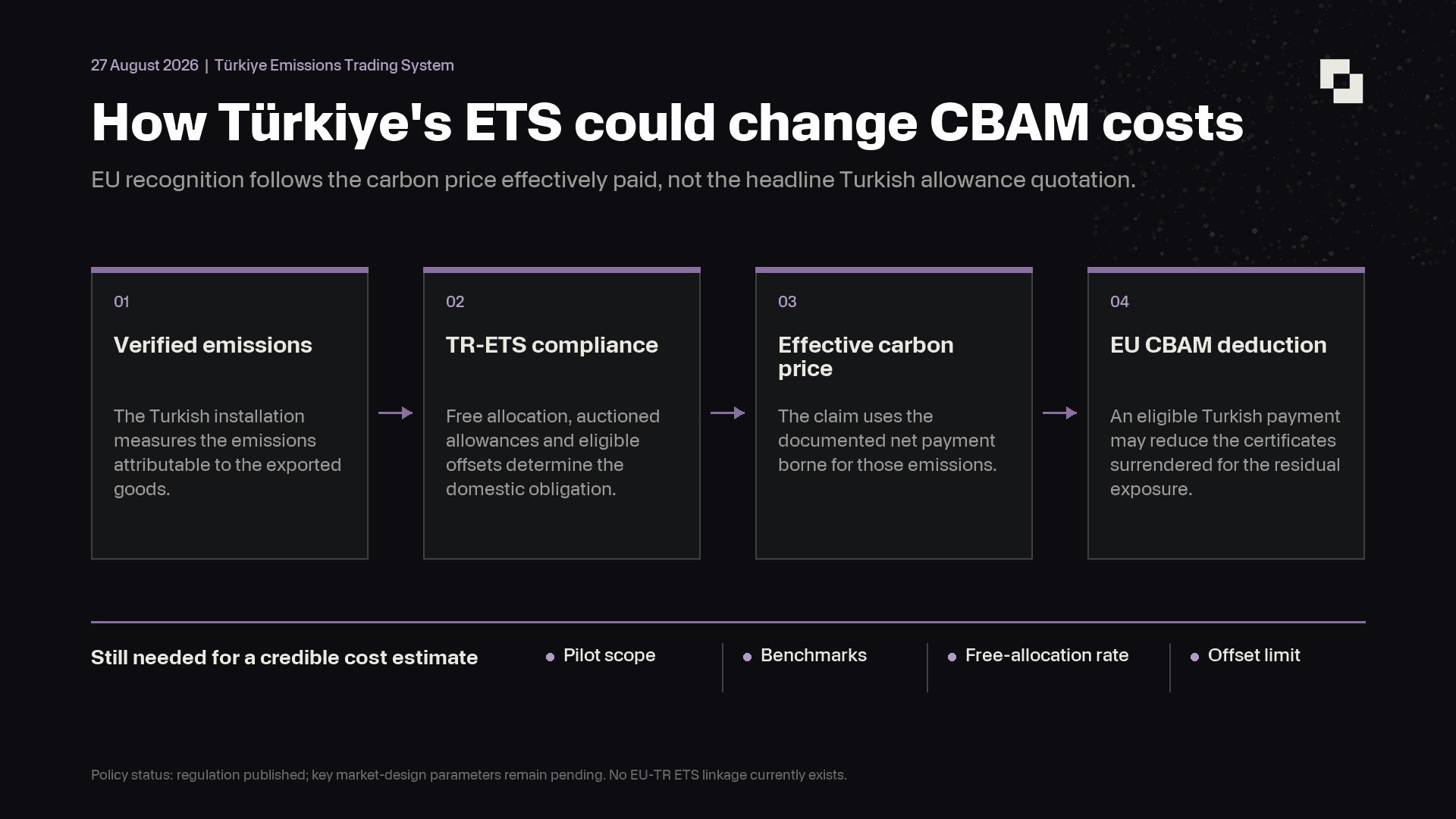
Turkish MRV and CBAM calculate different obligations
Türkiye has operated installation-level MRV since 2015, using accredited verifiers and a central assignment system. During the EU's 2023-2025 reporting period, actual emissions data were used for about 90% of Turkish shipments above 1,000 tonnes, according to the Ministry of Trade. Large exporters therefore start with more measurement experience than suppliers that relied mainly on EU default values during the transitional period.
TR-ETS verification and CBAM verification do not calculate the same obligation. The Turkish system establishes an installation's annual emissions, activity and allowance balance. CBAM assigns embedded emissions to specific goods entering the EU, including relevant precursor emissions and the EU free-allocation adjustment. A Turkish verification report can support the calculation without replacing the product-level evidence required by CBAM.
A supplier below the 50,000-tonne threshold may provide verified actual emissions while paying no TR-ETS allowance cost. Its EU customer can use the emissions data, but there is no TR-ETS carbon payment to deduct. A larger installation can support a deduction only for the portion of its domestic carbon cost that meets the EU criteria.
A Turkish steelmaker's production route determines its gross embedded emissions, while the deduction depends on the allowance cost paid by that installation. Steel made in an electric arc furnace with relatively low-carbon electricity may therefore carry fewer embedded emissions than steel from an integrated blast furnace without generating a larger Turkish carbon-price deduction.
Pilot installations may have to submit their first Monitoring Methodology Plans by 27 October 2026 unless the deadline is extended. EPIAS must also publish the procedures needed for auctions, secondary trading and the registry. Until the Board issues the pilot decision and first National Allocation Plan, TR-ETS belongs in CBAM scenarios rather than confirmed cost forecasts.
For 2027 contracts, an EU importer should obtain the supplier's verified embedded emissions and separate evidence of the carbon payment attributable to those emissions after free allocation. A Turkish allowance quote on its own is not enough to support a CBAM deduction.
